
|
|
|||||||
| Luftwaffe and Axis Air Forces Please use this forum to discuss the German Luftwaffe and the Air Forces of its Allies. |
 |
|
|
Thread Tools | Display Modes |
|
#1
 13th March 2010, 20:14
|
|||
|
|||
|
Re-visiting the Bf 109G-14…
The Bf 109G-14 is thought to be a common version of the Gustav series and, probably due to this classification, it has - in my view - been quite overlooked.
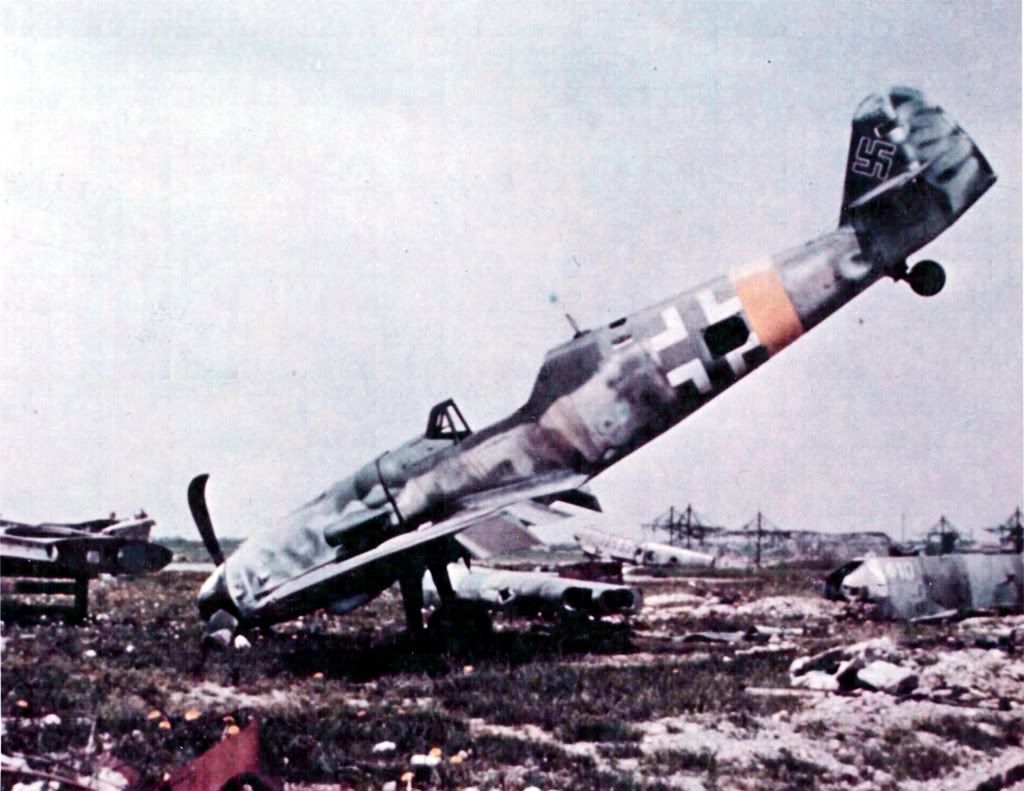
My attention has been recently pointed to an apparently secondary detail: the position of the circular hatch on the port side of the nose covering the access to the oil filler cap of the nose oil tank. The position of such hatch denotes which type of oil tank was mounted on the Bf 109: a lower one (just on top of the first nose air scoop) indicates a typical 36-litres oil tank with a horseshoe shape, usually associated with the DB605A and AS and used since the G-1 version. A higher round hatch (about 20 cm - 6.5 inches over the nose air scoop) indicates the presence of the bigger 50-litres oil tank of annular shape, usually associated with the DB605D engine. This the theory generally accepted so far. A theory that for the G-1 to G-6 versions duly applies, as well as for the G-14/AS up to the K-4. The only "hole" in that theory is the G-14 itself. All the evidence that I have collected so far, seems to indicate that, with the probable exception of the very early G-14 batches produced, the main core of the G-14 produced (and this include for the great majority those built by Erla Leipzig), shows the higher nose round oil filler hatch. This indicates that those G-14 were equipped with the bigger annular oil tank which - at this point - cannot be considered anymore as and indication of the presence of the DB 605D. To add further confusion, it is also correct to say that all the G-14/AS seen so far (the vast majority of which produced by MTT) do "correctly" shows the lower oil filler hatch… First to draw out any conclusion (there would be many…), I would like however to profit of the knowledge and the archives of the many researchers/enthusiasts/collectors reading this site to ask for proofs confirming or denying what I think to have found. Thus, please do examine closely the nose port side of any alleged G-14 image and look at the position of the oil filler hatch. As far as I am concerned, all the ones I have seen (apart from the RAF captured one with W.Nr. 413598, i.e. an early production one) do show the higher oil filler hatch. Certainly all the examples of the 464xxx batch, but also others. I do hope to start a debate and to show that research can be made also collectively. It is a hope but also a target. Thanks for your attention.
__________________
All the best, Ferdinando D'Amico 
|
|
#2
13th March 2010, 20:29
|
||||
|
||||
|
Re: Re-visiting the Bf 109G-14…
After reading this as well your analyze of the black 4 captured in Italy, from many sources credited as G-10, I really don't know what I have in hands when look at some images I have. One question- is the G-14 regular manufactured version or just emergency compilation made from many available elements and parts?
__________________
Srecko Bradic Owner: www.letletlet-warplanes.com Owner: www.letletlet-warplanes.com/forum Owner: www.sreckobradic.com Owner: www.warplanes-zine.com Email: srecko.warplane@gmail.com Skype: sreckobradic Facebook http://www.facebook.com/pages/LetLet...s/308234397758
|
|
#3
13th March 2010, 20:54
|
|||
|
|||
|
Re: Re-visiting the Bf 109G-14…
Quote:
This does not imply that sometimes "emergency" solutions weren't used to optimize the use of already produced parts and/or to keep production going (one example is the lower - double chin bulged - cowl of the G-14/AS taken from the K-4 production at MTT and the use of the G-5 engine cowl - double bulge on stbd side - on most of the G-14 production at Erla). There are very few things written in stone, particularly in the late Bf 109 production, but solutions seems to have always been logical, once known what the problem was...
__________________
All the best, Ferdinando D'Amico Last edited by veltro; 13th March 2010 at 21:35.
|
|
#4
13th March 2010, 21:12
|
||||
|
||||
|
Re: Re-visiting the Bf 109G-14…
Thank you very much for explanation

__________________
Srecko Bradic Owner: www.letletlet-warplanes.com Owner: www.letletlet-warplanes.com/forum Owner: www.sreckobradic.com Owner: www.warplanes-zine.com Email: srecko.warplane@gmail.com Skype: sreckobradic Facebook http://www.facebook.com/pages/LetLet...s/308234397758
|
|
#5
13th March 2010, 21:36
|
||||
|
||||
|
Re: Re-visiting the Bf 109G-14…
__________________
Srecko Bradic Owner: www.letletlet-warplanes.com Owner: www.letletlet-warplanes.com/forum Owner: www.sreckobradic.com Owner: www.warplanes-zine.com Email: srecko.warplane@gmail.com Skype: sreckobradic Facebook http://www.facebook.com/pages/LetLet...s/308234397758
|
|
#6
14th March 2010, 20:16
|
|||
|
|||
|
Re: Re-visiting the Bf 109G-14…
Hello,
some time ago I read (regrettably I do not remember where) that originally for the G-14 the designation G-6/MW50 was considered but eventually not adopted by the RLM. This suggests that the G-14 was essentially a G-6 with MW equipment. Apart from the installation of a DB 605 AM engine, this necessitated a few modifications: Since the MW tank was placed into fuselage section 2 (i.e. immediately behind the cockpit), the master compass had to be moved from there further to the rear (to section 6). Because the MW tank was fitted behind the c. g., the latter was moved further rearward, and to prevent the aircraft to become tail-heavy, the (rather weighty) battery was moved from section 6 forward to where the small luggage compartment had been, namely to section 1 just behind the slanted upper rear cockpit wall. Since the battery did not fit entirely under the compartment door, that had to be modified by adding a box-like structure, which is visible through the transparent canopy on G-14s and G-10s. If my explanation is correct, this "box" is the decicive external feature to tell a G-14 from a G-6. All other features, like a small or a tall fin, a three piece or an Erla hood, a short or a long tail wheel leg, small or large wing bulges (according to the size of the main wheels), and, for that matter, a 38 l or a 50 l oil tank etc., seem to be merely accidental (although some of those features are probably found on only one of the two subtypes). - Perhaps it should be added here that the said "box" disappeared again on the K, because on that type the rather heavy radio equipment was moved forward from section 4 to section 3, so the battery could be placed there too. (This is why also the port hatch was moved from section 5 to section 4.) Best regards, klemchen
|
|
#7
15th March 2010, 09:28
|
|||
|
|||
|
Re: Re-visiting the Bf 109G-14…
Klemchen,
thanks for your reply. It is correct that - in theory - the presence of the MW-50 should be one of the G-14s trademarks (or the only one, following your post). However, there are proofs that several G-14s* were produced/delivered without the MW-50 device, so even this important detail has to be considered not "crucial" as it was thought to be. Sure, it is difficult if not downright impossible to determine visually the presence or not of MW-50, especially because such machines apparently still showed the battery "box" on the rear cockpit section (one of them was the W.Nr. 464380 of which I have a cockpit detail). It is thus correct to say that the G-14 "should" have the MW-50, but also that this was a rule not always followed... About the presence of the bigger nose oil tank instead, since rarely things made by Erla were casual, I do suspect that this (undocumented on paper) modification was probably applied to definite batches of G-14s, probably all the 46x xxx lots, though I am still searching for further proofs... *from the listings of Bf 109s in charge to his unit, Cap. Mario Bellagambi (CO 5a Sq. 2° Gr.C. ANR) clearly indicated the following G-14s as devoid of MW-50 equipment: W.Nr. 464380; W.Nr. 464430; W.Nr. 464446; W.Nr. 464456; W.Nr. 464464. It is interesting to notice that these were - on late February 1945 - all the 464xxx examples in the unit.
__________________
All the best, Ferdinando D'Amico
|
|
#8
18th March 2010, 19:40
|
|||
|
|||
|
Re: Re-visiting the Bf 109G-14…
Hello Veltro,
thanks again. I am still inclined to think that the crucial feature of the G-14 was the MW equipment (provided the information was correct that originally the designation G-6/MW50 was considered for it). This does not exclude that some "irregular" aircraft were built under the same designation. Perhaps one should be more cautious and consider a G-14 a sort of G-6 which was adapted to take the MW equipment if available. In this context it would be interesting to know if the Italian G-14s without MW had their master compass in fuselage section 6 and the "box" on the lid of their luggage compartment. Another question that occurred to me is whether the G-14 and the G-10 were being produced in parallel by Erla. If so, the reason must have been that there were not enough D engines available and producing G-14s instead of G-10s was merely a stopgap measure. This would also explain why some Erla G-14s were equipped with the 50 l oil tank: The company just did not want to keep two types of tank in store. Best wishes, klemchen
|
|
#9
19th March 2010, 02:26
|
|||
|
|||
|
Re: Re-visiting the Bf 109G-14…
Klemchen,
it's true that the absence of the MW-50 could be probably considered "irregular" in the G-14, yet it is at least curious that these do appear with such regularity among 464xxx production, as well as the fact that all were delivered together. Quote:
Quote:
As a matter of fact I have yet to see (and would love to) a photo of any G-14 at least of the 463xxx and 464xxx batches having the smaller oil tank, and that could means many more than "some". Thanks for your contribution.
__________________
All the best, Ferdinando D'Amico
|
|
#10
21st March 2010, 20:34
|
|||
|
|||
|
Re: Re-visiting the Bf 109G-14…
Hello Veltro,
thank you again. I should think that the "irregular" G-14s without MW equipment were delivered in that state because some essential piece of that equipment was not available and the Germans could not afford withholding them. After all, a 109 without MW was better than no 109 at all. And I suppose the designation G-14 was given to those aircraft as well because they were produced within the G-14 contract. Best regards, klemchen
|
|
| Thread Tools | |
| Display Modes | |
|
|
 Similar Threads
|
||||
| Thread | Thread Starter | Forum | Replies | Last Post |
| I./JG 76 losses on op. Market Garden | Peter Kassak | Luftwaffe and Axis Air Forces | 24 | 11th September 2021 16:48 |
| FW190a-3 /A4 AGr123 in France 1943 1944. | Eric Larger | Luftwaffe and Axis Air Forces | 16 | 12th June 2011 10:29 |
| Searching a fate of Bf110C-7's. | Evgeny Velichko | Luftwaffe and Axis Air Forces | 18 | 2nd March 2011 14:32 |
| Losses - III./JG76 in October 1944 | Andre Stewart | Luftwaffe and Axis Air Forces | 10 | 14th October 2009 11:06 |
| Documentation of 2000HP Bf 109s of 1945 | Kurfürst | Luftwaffe and Axis Air Forces | 5 | 10th September 2009 13:15 |


 Linear Mode

